
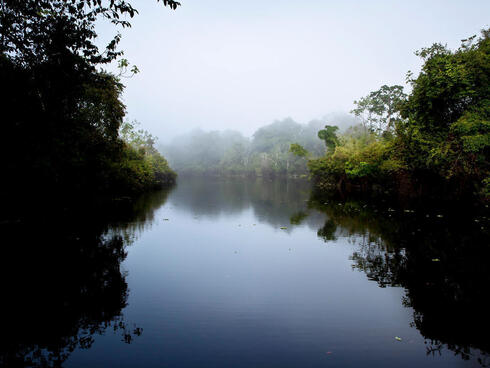
Sue Butler-Cole gave a 30-minute talk about this Amazonian Forest Project the Biological Dynamics of Forest Fragments Project (BDFFP) where she had worked from late 1979 until early 1982. It was originally called the Minimum Critical Size of Ecosystems. This project was to identify the minimum critical size of a forest reserve so that there would be no loss of species. In the 1970’s there was a very ambitious Brazilian Government program of national park development in Amazonia, but the big question was whether these new parks were going to be large enough to protect all the species within them. In 1977 Dr. Thomas E. Lovejoy learned about the law stipulating that 50% of land purchased from the Government had to be left intact. He came up with a plan to isolate various sized forest reserves starting with 1 hectare up to 1,000 hectares and study the rate of species loss due to their isolation. In 1979 the WWF and the Brazilian National Institute for Amazon Research (INPA) set up the BDFFP project with the intention of finding answers to the debate about single large or several small reserves (SLOSS). After 45 years the project is still going strong because long term data statistics are so valuable and make it possible to answer questions which were not part of the original project design. To date the project has produced 140 PhD & Masters graduates (of which more than half are Brazilian) plus an enormous number of scientific publications.
See Wikipedia regarding:
https://en.wikipedia.org/wiki/SLOSS_debate
Biological Dynamics of Forest Fragments Project https://en.wikipedia.org/wiki/Biological_Dynamics_of_Forest_Fragments_Project

 Rotary Clube de Silves